
The House Always Wins: Day Trading vs. Wealth Building
Ever since modern financial applications packed a live trading screen into your pocket, a dangerous illusion has been marketed on a global scale: "Move fast, capture every wave, get rich in front of a screen." Instant notifications, flashing green indicators, and synthetic success stories on social media deliberately try to drag you into non-stop transactional chaos.
Yet behind these polished user interfaces lies a cold trap validated by raw data and mathematical truth. The moment you convert the market into a playground and treat equities like digital gambling chips, you unconsciously step into the gears of a machine optimized to liquidate your portfolio. The house always wins—unless you refuse to play by its rigged parameters.
The Immutable Law of Probability: The Illusion of Catching Waves
When you audit the empirical data tracking short-term day traders, the structural reality is staggering. Academic consensus and brokerage disclosure data confirm that upwards of 90% of active retail traders destroy their own capital footprint across a long horizon. This failure rate is not driven by a lack of intent; it is a structural mathematical constraint.
By executing high-velocity, short-term trades, you are actively waging a campaign against systemic noise, high-frequency institutional algorithms, and continuous transaction friction. Across micro-timelines, price movements reflect random distribution. Attempting to decode this randomness is functionally identical to guessing the next color on a casino roulette wheel. We do not gamble; we build on data integrity and structural stability.
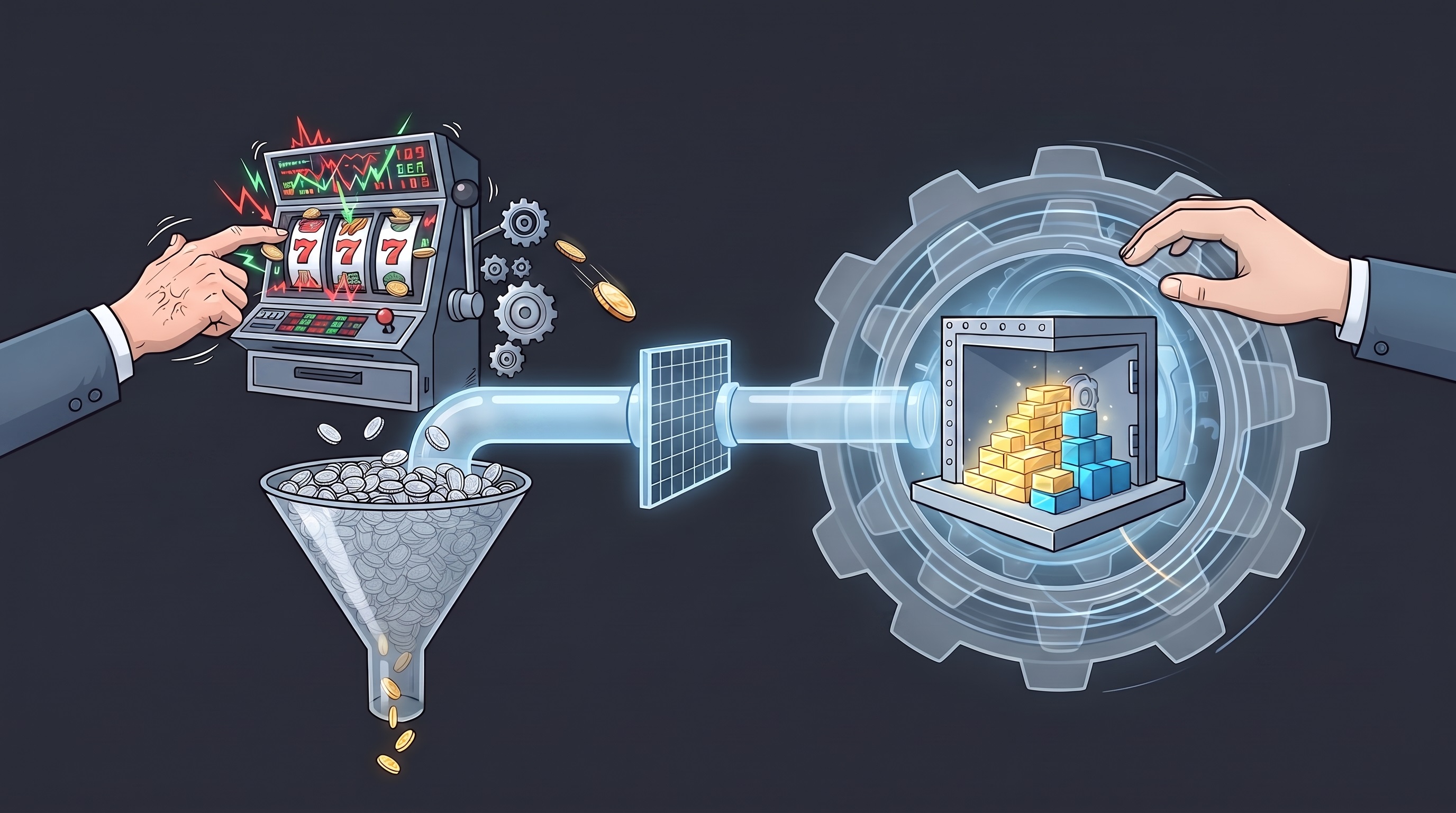
The Sovereign Line: Calculated Investing vs. Emotional Gambling
How do you diagnose the thin, invisible boundary separating a calculated capital allocator from an emotional gambler? It is entirely determined by the core motivation behind your execution and your systemic framework.
If your entry decisions are triggered by the fear of missing out (FOMO), a neurological craving for excitement, or the ambitious dream of overnight multipliers, you are operating inside the casino quadrant—regardless of what your broker calls it. True calculated investing, conversely, zeroes out this sensory feedback. You do not acquire an asset because a chart line looks aggressive; you integrate it into your architecture because you have verified that the underlying business generates real-world utility, robust net margins, and operational efficiency. The gambler tracks the price ticker; the investor studies the system.
Reclaiming Time Sovereignty: From Casino to Laboratory
The exact millisecond you stop allowing the market's volatility to govern your nervous system, you secure your financial autonomy. Instead of visualizing the market as an intense storm requiring constant monitoring, you must configure your portfolio as a quiet, background system utility that compounds capital independently of your physical labor.
Day trading siphons away your intellectual energy and robs you of your finite time. Real wealth generation is the exact opposite: the science of leveraging time as a multiplier. Corporate production, true innovation, and the underlying physics of compound interest demand long temporal horizons to run their optimization algorithms. Filter out the noise of flashing numbers, extract your capital from speculative tables, and manage your wealth with the cold, data-driven discipline of an engineering laboratory. Your future is far too valuable to be bartered away for transactional adrenaline.